
How to Check for a Warrant in Lee County
A Lee County warrant check starts at the court level. Virginia OCIS lets anyone search participating Lee Circuit, General District, and J&DR cases by name, case number, or hearing date. It is case information, not an all-warrants database. A name match, or a BW or CAP event, is a reason to call the court rather than proof that process is still active. Bring a case number, citation, or notice if you have one. Helping a relative? Ask which court or town police department handled the matter. In Lee County, public contact runs through the clerks, the magistrate, and law enforcement rather than one warrant desk.
- Choose the likely court in OCIS: Lee General District Court for adult traffic and misdemeanor matters, Circuit for circuit criminal files, or J&DR where appropriate.
- Search by name, case number, or hearing date. The name field requires at least two characters, while exact or partial matching rules are not posted.
- Write down the court, case number, and event label. Ask the matching clerk whether the event is current, withdrawn, or otherwise resolved.
- Call the Lee magistrate for a new complaint or probable-cause question, and call the sheriff for service or safety routing. Neither is a public warrant search.
- Before travel, payment, or surrender, ask the issuing court or an attorney what step applies to that case.
The Virginia court self-help page explains public case lookup and why J&DR information may be limited. It helps Lee County readers pick a route.
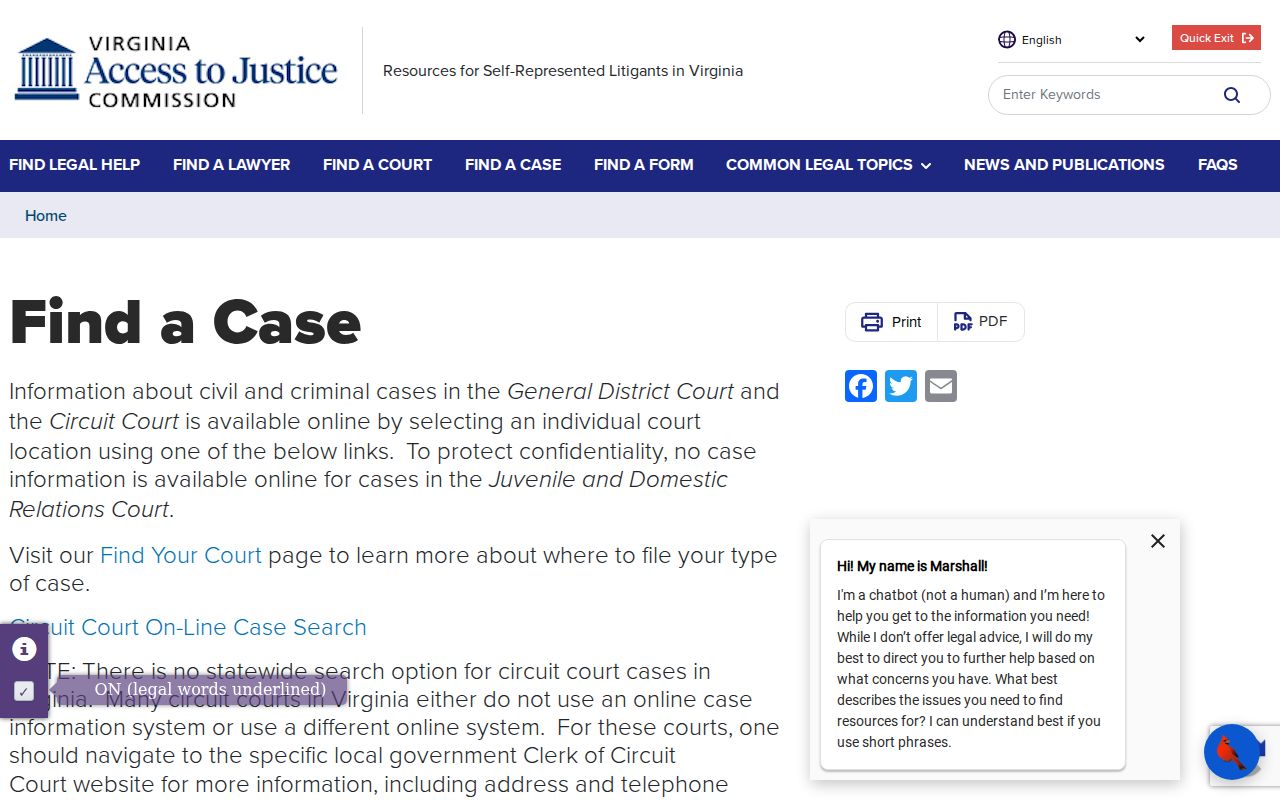
The tips help you choose a search route. Still, the issuing clerk answers for a specific Lee County case.
Lee County Warrant Search Begins With the Court
OCIS is a case lookup, not a statewide warrant database. For Lee County, the court codes are 105C for Circuit, 105G for General District, and 105J for J&DR. Sealed, protected, or very recent entries may not appear in public results. Pick the court by case type. Circuit holds felonies and circuit criminal files, GDC covers adult traffic and misdemeanors, and J&DR handles juvenile, family, and designated adult matters with narrower access. Then call the clerk for status.
Types of Warrants in Lee County
Virginia courts use several forms of process. In Lee County, a label on a case screen describes an event or an order, and the reason behind it depends on the case. A search warrant authorizes a search, not an arrest. A summons orders an appearance, which differs from a command to take someone into custody.
| Type | How It Arises | Lee County Route |
|---|---|---|
| Arrest warrant | A sworn complaint and probable-cause finding support an order to arrest. | Magistrate or authorized court; confirm with the issuing office. |
| Bench warrant | A court event may follow a missed required appearance or another court obligation. | Lee GDC, Circuit, or J&DR, based on the case. |
| Capias | Virginia case systems use this court-process term; the record context controls. | Check the event with the issuing clerk. |
| Search warrant | A judge or magistrate authorizes a search under applicable law. | Not an arrest warrant or a public name-search result. |
Traffic nonappearance follows separate statutes and may bring court process or a DMV notice. Texas's capias pro fine is no Lee County rule.
What BW and CAP Mean in Lee County
OCIS event labels include BW for a bench warrant issued and CAP for a capias issued. BWW and CAPW mark withdrawals. BWX and CAPX mark an arrested event. The codes are clues only; a label alone does not confirm what a Lee County court can enforce now or whether another obligation remains.
- BW / BWW / BWX
- Bench-warrant event, withdrawn event, or arrested event label.
- CAP / CAPW / CAPX
- Capias event, withdrawn event, or arrested event label.
- FTA
- Failure to appear. The court file and law govern what followed.
Note: Save the court and case number beside the event code so a Lee County clerk can pull the correct file.
What a Lee County Warrant Record Shows
A public case view may show only a few fields: a party label, a hearing date, a charge, and an event. More may sit in a Lee County clerk's file or be withheld by law. Not every record has a warrant number. Not every record lists a bond amount.
| Court and locality | Lee Circuit, GDC, or J&DR identifies the case route; OCIS uses court codes 105C, 105G, and 105J. |
|---|---|
| Case number | The number ties a question to the clerk's file. The portal does not post one universal Lee format. |
| Charge and class | May show an offense description and a felony, misdemeanor, or infraction category. |
| Hearing or event | Can show a date and a code such as BW, CAP, BWW, or CAPW. |
| Bond and return | Bond actions or service returns may appear, but public rows do not expose every field. |
Lee County courts share no single case-number format. Ask the clerk to explain any entry that changes your next step.
Lee County Court Dockets Are Not Warrant Checks
In Lee County, Lee GDC puts Jonesville Police cases at 1 p.m. on first Wednesdays and Pennington Gap Police cases at 1 p.m. on third Wednesdays. Other blocks cover deputies, arraignments, bond hearings, and motions. A Lee County docket shows a setting for a case type, not a named person's warrant status. Town police cases go through Lee GDC. Lee County has no separate municipal court. Circuit and J&DR keep separate files and calendars, so check OCIS and call the GDC clerk for the right one. The official Lee GDC page posts contacts and schedules.
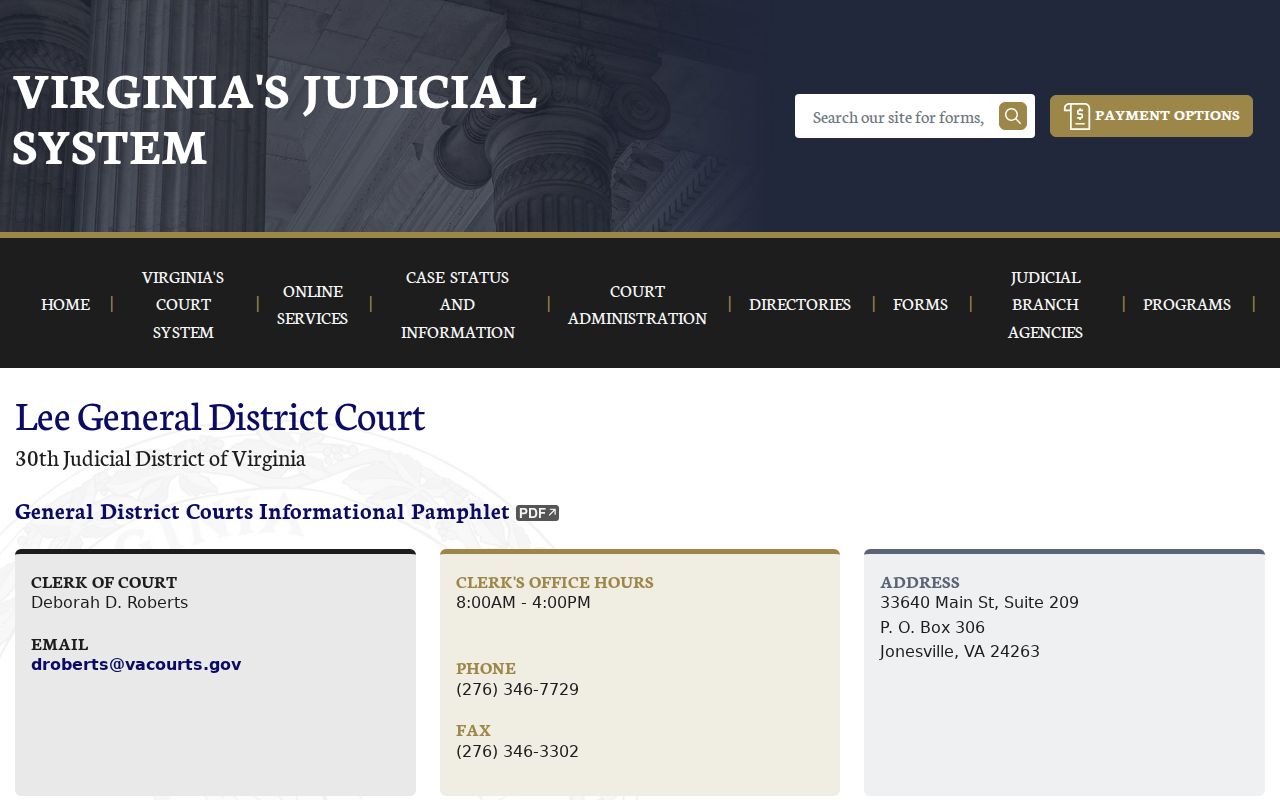
That page is a docket reference, not an individual warrant result.
Who Issues and Serves Lee County Warrants
A magistrate or a court issues the process. A clerk keeps the case record and explains access. Under Virginia law, the Lee County Sheriff's Office and town police may serve what is assigned to them. The jobs differ, and a serving office cannot change the Lee County issuing court's order.
Lee County Sheriff's Office
33640 Main Street, Suite U101
Jonesville, VA 24263
Office 276-346-7753
Non-emergency 276-346-7777
Call Circuit Clerk Rene Lamey for circuit criminal files. Call Lee GDC for adult traffic or misdemeanors. For complaints, probable cause, or bail, use the courthouse magistrate at Main and Church Streets; Lee County posts no public warrant desk.
Lee County Sheriff Records and Warrant Status
The Lee County sheriff's public site lists contact details, civil-process information, a tip route, and arrest or jail-commit reports. It publishes no searchable active-warrant list. No most-wanted roster appears there either. Weekly arrest reports are not a substitute for the issuing court's current file. The sheriff's contact form accepts general messages, not warrant lookups or formal FOIA requests. Use it for routing only. The non-emergency line is a general contact as well, not a warrant hotline. The Sheriff's public contact page routes general questions in Lee County.
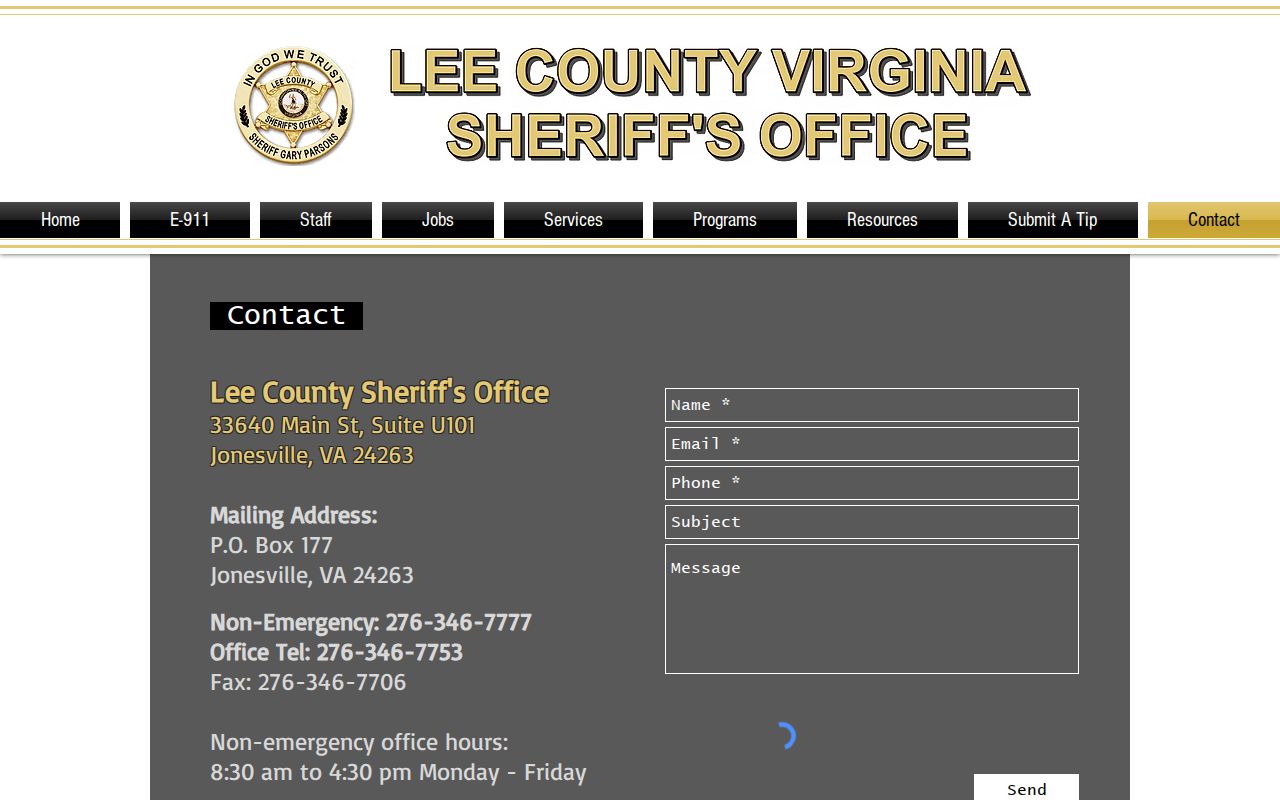
For warrant status, call the issuing Lee County clerk; use law enforcement only for service or safety questions.
What to Do If You Have a Lee County Warrant
Call the clerk who issued the warrant and ask whether it is still active. Lee County publishes no walk-in surrender window, standard bond schedule, or recall form, so confirm the right office before you drive anywhere. The clerk can tell you if the next step is a motion, a court appearance, surrender instructions, or a bond hearing. An attorney can help you weigh the case.
Confirm before travel. Contact the issuing clerk or an attorney about the correct office, calendar, and procedure before appearing or making a payment.
The Southwest Virginia Regional Jail Authority's Duffield facility holds people in regional custody. It cannot tell you a Lee County warrant's status. A jail locator or VINE alert will not show an unserved order, either. Virginia courts also warn that urgent demands for gift cards or cryptocurrency are not legitimate court payments.
Fines and Warrant Status Are Separate Lee County Questions
Lee County fines and warrant status are two different questions, and the Lee GDC payment policy only speaks to the first. For balances of $500 or less, the policy asks a 10 percent down payment. Above $500, the figure is 5 percent or $50, whichever is greater. Clerk-approved plans can run up to 12 months. Longer terms need a judge's approval. Paying on a plan does not automatically recall a warrant or clear a separate court event, so ask the clerk about the balance, any appearance requirement, and any other order. One more caution: the sheriff's $12 in-state and $75 out-of-state civil-service charges are not warrant fees. Stick to the court's payment route, and verify any unexpected demand with an official office. The clerk can confirm current terms.
Public Access to Lee County Warrant Records
Virginia FOIA starts from the presumption that records are open unless an exemption applies. Describe what you want with reasonable specificity and send a written request to the county's identified FOIA officer. The Lee County response may hand over records, deny them with a cited reason, report that none exist, or estimate copying costs.
Access rules:
Virginia Code § 2.2-3704 sets request and response steps, including the general five-working-day response period.
Virginia Code § 2.2-3706 covers access to law-enforcement records and allows limits for protected information.
Virginia Code § 16.1-301 restricts juvenile law-enforcement records; J&DR access also follows § 16.1-302.
Some Lee County records stay closed: sealed, expunged, juvenile, protected family material, and files tied to ongoing investigations. A clerk can explain the lawful access route without revealing protected facts.
Federal Warrant Records for Lee County Use Another Court
Federal warrants never show up in Virginia OCIS. Lee County sits in the Western District of Virginia's Abingdon Division, where PACER is the federal docket system. CourtListener and RECAP may archive filings, but neither is a warrant list. So a blank state search tells you nothing about federal process. The federal clerk keeps the court records, and the U.S. Marshals Service handles fugitive duties. Ask the proper federal office or an attorney; town police, the sheriff, and Lee County court clerks each work a different route.
Ask for Lee County Warrant Totals Without Personal Names
You can ask for warrant numbers rather than names. Under Virginia FOIA, ask whether an agency keeps monthly, non-identifying counts of warrants received, issued, served, returned, or withdrawn, sorted by court and date range. Request existing records only. Warrant events are distinct from arrest reports. Send the Lee County FOIA officer a date range, office, record type, and format through the Board of Supervisors page, and request a cost estimate. FOIA does not force the county to create a new count, and investigative exemptions may apply. That route covers county records, not a decision about any person's warrant status.
Warrant Records by City in Lee County
Both of Lee County's incorporated towns sit in its 2020 Census population order, and neither one runs its own municipal court or town warrant portal online. Police matters in either town land on the Lee General District Court docket. So call the town police first for the warrant question. Then have the court clerk confirm the case. That two-step covers every city in Lee County.
Pennington Gap Warrant Records
Population 1,624 in 2020; town police cases route through Lee GDC.
Jonesville Warrant Records
Population 872 in 2020; county seat with a first-Wednesday GDC police docket.
Jonesville is the Lee County seat and the courthouse location. Pennington Gap keeps a separate town directory and police contact. Adult traffic and misdemeanor cases from both towns travel the same county court path.